Mastering American English Phonetics for Spanish speakers.
This crash course provides Spanish speakers with a solid foundation in American English phonetics. Since you already pronounce Spanish sounds naturally, this guide uses a powerful comparative method, contrasting the English sound system directly with Spanish to build your pronunciation awareness.
Why Pronunciation Matters
Pronunciation is often overlooked, but focusing on it early is critical for two key reasons.
- Clarity: Incorrect pronunciation forces native and non-native speakers to struggle to understand you, hindering communication.
- Listening Comprehension: When you pronounce sounds correctly yourself, you also hear and distinguish them better, accelerating your overall English learning.
Vowels: The Core Challenge
The greatest difference between the two languages lies in the vowel system. While Spanish utilizes just five distinct vowel sounds, English employs approximately twelve monophthongs and several diphthongs. This significant expansion, coupled with the introduction of neutral (lax) vowels, forces Spanish speakers to learn entirely new muscular movements to distinguish words that sound identical to the untrained ear.
| Feature | Spanish Vowels | American English Vowels |
|---|---|---|
| Phonetic Count | 5 phonetic vowels | Approx. 12 phonetic vowels |
| Tongue Position | Only Extreme/Peripheral positions. | Uses Extreme and Intermediate (Mid) positions. |
| Lip Position | Only Active (Rounded/Spread) positions. | Uses Active and Neutral (Relaxed) positions. |
| Muscle Tension | Only Tense vowels are used. | Uses both Tense Neutral (Lax)and vowels. |
Spanish Vowels (The Tense 5)
In Spanish, all five vowels are tense—the tongue reaches extreme, well-defined positions, engaging the muscles:
| Vowel (Phonetic) | Tongue Position | Lip/Mouth Position |
|---|---|---|
| i | High and forward, close to the palate. | Lips stretched, mouth almost closed. |
| e | Mid-high and forward. | Lips stretched, mouth slightly open. |
| u | High and pulled back. | Lips rounded and forward (a “pout”), mouth closed. |
| o | Mid-low and back. | Lips rounded, mouth slightly open. |
| a | Low and flat at the bottom of the mouth. | Mouth and lips fully open. |
Before moving to the English vowels, let's break down the 3 basic features to understand how vowels are formed:Tongue Position , Lip Position, and the Muscle Tension that controls them.
1. Tongue Position: Extreme vs. Intermediate
Vowels are speech sounds where the airflow passes through the mouth unobstructed. To visualize how vowel sounds are made, phoneticians use the vowel triangle .
The difference in vowel position is stark:
- Spanish (Extreme/Peripheral) : Spanish vowels are always formed with the tongue at the edges or corners of the vowel triangle (the periphery). This requires maximum muscular effort to position the tongue as far forward, back, up, or down as possible.
- English (Extreme AND Intermediate) : English uses the same extreme positions as Spanish for its tense vowels , but it also introduces vowels formed with the tongue in the middleor intermediate area of the mouth. These are the neutral (lax) vowels , and they do not exist in Spanish.
2. Lip Position: The Five Degrees of Lip Shaping
Lip position is the second crucial component, controlling the shape and length of the vocal tract's exit. Spanish requires only fully active lip positions, while English uses a spectrum that includes intermediate and passive positions.
The five degrees of lip shaping are:
- Fully Spread (Extreme Shaping, Spanish & English): This is the maximum retraction of the lips, like a wide smile. The lips are stretched tightly and close the mouth opening.Context: Used for very high, front, tense vowels, such as the vowel in sheep /i/ and Spanish /i/.
- Fully Rounded (Extreme Shaping, Spanish & English): This is the maximum protrusion of the lips, pushed forward into a tight circular shape (a "pout").Context: Used for very high, back, tense vowels, such as the vowel in boot /u/ and Spanish /u/.
- Semi-Spread (Intermediate Shaping, English Only):The lips are spread but with significantly less tension than the “fully spread“ position. The corners of the mouth are slightly pulled back, but the shape is relaxed and wider than fully rounded.Context: Used for mid-front lax vowels, such as the vowel in bed /ɛ/ and ship /ɪ/.
- Semi-Rounded (Intermediate Shaping, English Only): The lips are rounded but with less protrusion and much less tension than the “fully rounded“ position. The circular opening is relaxed and wider.Context: Used for mid-back lax vowels, such as the vowel in dog /ɔ/ (for speakers who round it) and book /ʊ/.
- Neutral (Passive, English Only): The lips are completely relaxed and passive. They are neither actively rounded nor actively spread. The mouth opening is minimal, and the jaw is only slightly dropped. This position is nonexistent in Spanish.Context: Used primarily for the schwa /ə/ and other highly centralized, lax vowels.
For Spanish speakers, mastering these intermediate and neutral positions—learning to use less muscle tension in the lips—is vital for sounding natural in English.
3. Muscle Tension: The Tense and Neutral Vowels
The fundamental concept that dictates the creation of all English vowels is muscle tension. It is the unifying force that controls both the position of your tongue and the shape of your lips, and mastering the shift between high and low tension is absolutely key to pronouncing English vowels correctly.
- Tense Vowels: These are produced with high muscle tension in the tongue and active lip positions (fully spread or fully rounded). They are like your five Spanish vowels (e.g: casa, cosa) or the English vowels in sheep /i/ and pool /u/. (e.g., the vowel in sheep /i/).
- Neutral (Lax) Vowels: These are produced with low muscle tension and the tongue is allowed to fall back toward the center of the mouth, resulting in an intermediate tongue position and semi-active or neutral lip position (e.g., the vowel in ship /ɪ/ or sofa /ə/). They don't exist in Spanish.
English Vowels
Here is a list of the approximate 12 American English monophthongs (single vowels) to highlight the distinction between Tense and Neutral:
| Vowel Type | IPA Sound | Example Word | Spanish Speaker Difficulty |
|---|---|---|---|
| Tense Vowel | /i/ | sheep | Similar to Spanish /i/ (long) |
| Neutral Vowel | /ɪ/ | ship | Often confused with /i/ |
| Tense Vowel | /u/ | boot | Similar to Spanish /u/ (long) |
| Neutral Vowel | /ʊ/ | book | Often confused with /u/ or /o/ |
| Tense Vowel | /ɑ/ | father | Similar to Spanish /a/ (low back) |
| Neutral Vowel | /æ/ | cat | No Spanish equivalent (low front) |
| Neutral Vowel | /ɛ/ | bed | Often confused with /e/ |
| Neutral Vowel | /ʌ/ | cut | Often confused with Spanish /a/ or /o/ |
| Neutral Vowel | /ə/ | sofa | The Schwa (most common, relaxed sound) |
| Neutral Vowel | /ɔ/ | dog | No exact Spanish equivalent (rounded) |
| R-Colored Vowel | /ɜr/ | bird | Includes the R-sound |
| Other Tense/Mid | /e/ | eight | Often a diphthong /eɪ/ in practice |
Minimal Pairs: Discriminate tense and lax vowel sounds
Since English uses both tense and neutral vowels that can sound identical to a Spanish ear, practicing minimal pairs (word pairs that differ by only one sound, like cat vs. cut or ship vs. sheep) is essential for vowel discrimination.
Diphthongs
Diphthongs are combinations of two vowel sounds within a single syllable. In English, they typically start with a tense vowel and glide toward a neutral one, with the energy decreasing gradually (e.g., the /aʊ/ sound in cow).
The most common American English diphthongs include the following:
| Diphthong | IPA Sound | Example Word | Glide Direction |
|---|---|---|---|
| "Long A" | /eɪ/ | say, late | From /e/ (mid-front) → /ɪ/ (neutral) |
| "Long I" | /aɪ/ | buy, time | From /a/ (low-back) → /ɪ/ (neutral) |
| "Oy" | /ɔɪ/ | boy, coin | From /ɔ/ (open-mid-back) → /ɪ/ (neutral) |
| "Long O" | /oʊ/ | no, boat | From /o/ (mid-back) → /ʊ/ (neutral) |
| "Ow" | /aʊ/ | cow, out | From /a/ (low-back) → /ʊ/ (neutral) |
Consonants
First, let's talk about what makes a vowel and a consonant.
- Vowel: Air flows freely; vocal cords vibrate.
- Consonant: Airflow is obstructed; vocal cords may or may not vibrate.
- Semivowel: A sound that functions like a vowel but is formed with some obstruction of the airflow (the R-sound)
Consonants: Voicing and Placement
The primary phonetic difference between English and Spanish consonants is voicing. Many English consonants exist in minimal pairs that differ only by whether the vocal cords are vibrating (voiced) or not (voiceless). Spanish, by contrast, relies less on voicing to distinguish meaning.
Major English Consonants by Voicing
This table shows the primary consonant sounds in English, organized into voiceless/voiced pairs. Sounds bold represent those that are often particularly challenging for Spanish speakers due to different articulation or the lack of a clear Spanish equivalent.
| Manner of Articulation | Voiceless IPA (No vibration) | Voiced IPA (Vibration) | Spanish Speaker Notes |
|---|---|---|---|
| Stops (Plosives) | /p/ (pat), /t/ (top), /k/ (cat) | /b/ (bat), /d/ (dog), /g/ (go) | Spanish voiced stops are often pronounced as softer approximants /β, δ, γ/ between vowels. English stops are harder and more explosive. |
| Fricatives | /f/ (fan), /θ/ (thin), /s/ (sip), /ʃ/ (ship), /h/ (hat) | /v/ (van), /ð/ (this), /z/ (zip), /ʒ/ (measure) | The /v/ sound does not exist in Spanish. The /z/, /θ/, and /ð/ sounds are highly distinct in English. |
| Affricates | /tʃ/ (chair) | /dʒ/ (judge) | The English /dʒ/ is often pronounced like the Spanish 'y' or 'll' sound /j/ by non-native speakers. |
| Nasals | /m/ (man), /n/ (no), /ŋ/ (sing) | No major difficulty. | |
| Liquids & Glides | /l/ (light), /r/ (red), /w/ (wet), /j/ (yes) | The English /l/ is often 'darker' (velarized) than Spanish /l/. The /r/ is the semivowel discussed below. |
Minimal Pairs: The Non-Shared Consonant Sounds
The sounds below do not have a direct equivalent in Spanish and require specific attention:
- Voiced Fricatives /z/ vs. Voiceless /s/: Spanish /s/ is typically voiceless. You must practice vibrating your vocal cords for the English /z/ (e.g., his vs. hiss).
- Voiced Fricative /v/ vs. Voiceless /f/: Spanish does not have a true /v/ sound; the letter 'v' is pronounced as /b/. You must use your upper teeth on your lower lip and vibrate your vocal cords for /v/ (e.g., fan vs. van).
- Palatal Fricatives /ʃ/ and /ʒ/: These are the 'sh' (as in ship) and the less common 'zh' (as in measure or vision) sounds.
- Dental Fricatives /θ/ and /ð/: The 'th' sounds (voiceless in think vs. voiced in them).
Minimal Pairs: Vowel Length (Pre-fortis Clipping)
It is a misconception that English has fixed "long" and "short" vowels. In fact, the does change systematically based on the following consonant—a phenomenon known as Pre-fortis Clipping.
The vowel sound changes in length depending on whether the following consonant is voiced (vocal cords vibrating) or voiceless (voiceless consonants):
- Vowels lengthen (or are held longer) before voiced consonants (b, d, g, v, z). This is because the vocal cord vibration continues for an extended period.
- Example (Longer Vowel): The vowel in 'bid' is noticeably longer than the vowel in 'bit'.
- Example (Longer Vowel): The vowel in 'bag' is longer than the vowel in 'back'.
- Vowels shorten before voiceless consonants (p, t, k, f, s). The vowel is 'clipped' or cut short.
This inherent length difference is a primary acoustic cue that helps native English speakers distinguish between words that otherwise sound very similar. Spanish speakers must learn to exaggerate this lengthening/shortening to sound more natural and to better perceive the difference when listening.
The Semi-vowel R: Retroflex R
The American R sound is perhaps the single most challenging sound for Spanish speakers to master due to its unique articulation and its effect on preceding vowels.
In Spanish, the r is a consonant, produced by either a tap (single /r/) or a trill (rolled /rr/) of the tongue tip against the palate. It is a sound made by obstruction.
In American English, the R (/r/) is an approximant semivowel—it is formed by curling the tongue tip upward and backward (a movement called retroflexion) or by bunching the tongue high toward the back of the mouth, without ever touching the palate. Air flows freely through a narrow channel above the tongue.
- Initial R: The R acts as a consonant. (e.g., red /rɛd/, run /rʌn/)
- Final R: The R often colors the preceding vowel. (e.g., car /kɑr/, four /fɔr/)
- Cluster R: The R merges with a consonant. (e.g., tree /tri/, drink /drɪnk/)
R-Colored Vowels (Rhotic Vowels)
A unique feature of American English is that when a vowel is followed by an r, the vowel and the r often merge into a single sound known as an R-colored vowel or a rhotic vowel.
In these cases, the vowel sound is distorted or “colored“ by the tongue's preparatory movement for the R-sound. The tongue starts moving backward and up almost as soon as the vowel begins, blending the two sounds together seamlessly.
Phonetic Clarification: While these sounds may feel longer or stronger to a Spanish speaker, the phonetic effect of the retroflex /r/ is actually to centralize the preceding vowel (pulling the tongue away from the extreme tense positions) as the tongue prepares to curl backward. This is the opposite of producing a "more tense" vowel.
| Sound Characteristic | Spelling Combination | IPA Sound | Example Word | Spanish Speaker Note |
|---|---|---|---|---|
| Low Back AR | AR | /ɑr/ | car, star | The Spanish /a/ sound must be followed by the strong retroflex R glide. |
| Mid-High IR | EER, EAR, IER | /ɪr/ | fear, hear, deer | The vowel starts similar to lax /ɪ/ before gliding into the /r/. |
| Schwa-R Merger | ER, IR, UR | /ɜr/ or /ər/ | bird | These spellings merge into a single, centralized R‑colored sound (stressed vowel in "bird"). |
| Mid-Back UR | OOR, URE | /ʊr/ | sure, tour, poor | A high-back lax vowel followed immediately by the /r/. |
| Rounded OR | OR | /ɔr/ or /oʊr/ | four, door, more | Involves lip rounding on the vowel, which is then quickly colored by the retroflex R. |
| Diphthongal ER | AIR, ARE | /ɛr/ or /eɪr/ | hair, care | Combines an /e/ quality with R-color, often realized as a diphthong plus /r/. |
Minimal Pairs: Discriminating difficult Rhotic Pairs
The combinations of short vowel sounds and the /r/ sound create some of the most subtle distinctions in English. Here are a few challenging minimal pairs and the key difference in articulation:
| Word Pair | Sound 1 (Vowel) | Sound 2 (Vowel) | Articulation Key |
|---|---|---|---|
| bird /bɜrd/ vs. bear /bɛr/ | /ɜr/ (Schwa‑R) | /ɛr/ (Diphthongal ER) | Bird requires the tongue to be centered and bunched (most neutral). Bear requires the tongue to be lowered and slightly forward to start the /ɛ/ sound. |
| four /fɔr/ vs. fare /fɛr/ | /ɔr/ (Rounded OR) | /ɛr/ (Diphthongal ER) | Four requires significant lip rounding (an O‑mouth shape) at the start of the vowel. Fare is produced with the lips unrounded (flat). |
| fire /faɪr/ vs. fear /fɪr/ | /aɪr/ (Long Diphthong) | /ɪr/ (Mid‑High IR) | Fire is a long, complex glide starting with an open mouth (/a/) before gliding high and back. Fear is shorter and starts with a higher, mid‑position tongue (less mouth opening). |
Mastering the retroflex and its effect on vowels is essential for reducing your accent and significantly improving your listening comprehension.
Rhythm and Intonation
The final components to achieving a natural, fluent sound are rhythm and intonation. Unlike Spanish, which gives roughly equal weight to every syllable, English uses a stress-timed system. This section will guide you through understanding how to properly stress words and sentences, which governs the overall cadence of English speech and is essential for comprehension.
Stress-Timed Rhythm
A major difference between the two languages is rhythm:
- Spanish is syllable-timed ; each syllable takes roughly the same amount of time.
- English is stress-timed ; stressed syllables are longer, clearer, and carry the main meaning, while unstressed syllables are reduced and weakened.
This difference is why English sounds like it has a characteristic “bouncy“ rhythm—you jump from one stressed beat to the next.
We can visualize this difference using a simple rhythmic pattern, where 'da' is an unstressed syllable and 'DA' is a stressed syllable:
- Spanish (Syllable-Timed): da-da-da-da (A steady, marching beat where every syllable is equal.)
- English (Stress-Timed): da-DA-da-da (The time between the 'DA' beats is kept constant, causing the 'da' syllables to be rushed and weakened.)
The Schwa Sound /ə/
This rhythmic pattern dramatically shapes English sounds. The Schwa is arguably the single most important sound for Spanish speakers to master, as it is directly responsible for the “stress-timed“ feel of the language.
- Stressed syllables contain one of the 12 full English vowels (tense or neutral).
- Unstressed syllables are reduced, often using the schwa /ə/ sound.
The schwa is the most common vowel sound in English—it accounts for nearly of all spoken vowels, making it the “lazy“ sound of English. It is a neutral, relaxed sound. To pronounce it: relax your mouth muscles completely, open your mouth only slightly (the jaw is barely dropped), and produce a weak, short “uh“ sound.
For Spanish speakers, the difficulty lies in the fact that the schwa often replaces what looks like a clear Spanish vowel (like 'a', 'e', or 'o') in words. Learning to identify and produce the schwa is vital because it is the acoustic cue that tells listeners which parts of the word or sentence are unimportant, allowing them to focus on the key stressed beats.
Examples of the schwa in action:
- Articles & Prepositions : The a in “a car“ /ə 'kar/, or the of in “cup of coffee“ /kʌp əv 'kɔf.i/.
- Multisyllabic Words: The first vowel in “about“ /ə 'baʊt/ or the second vowel in teacher /'ti.tʃər/.
Word Stress Patterns and Intonation
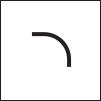
The intonation (pitch contour) of a word is directly tied to the placement of its stress. The main intonation movement (represented by the curve i) always occurs on the stressed syllable, making it the peak of the word’s pitch. All other syllables (represented by the dot $\bullet$) remain low and flat in pitch.
The key principle in the diagram is that pitch change only occurs on the stressed syllable.
- The Dash (–): Represents the stressed syllable. This syllable is pronounced longer, louder, and higher in pitch than the surrounding syllables.
- The Curved Line (⌢): Represents the stressed syllable occurring on the last stressed syllable of the word, and indicating a slight fall in intonation.
- The Dot (•): Represents the unstressed syllable. These syllables are reduced, often using the Schwa /ə/ sound, and are low and flat in pitch.
| Syllables | Pitch Marks | Example Word | Rhythmic Pattern |
| 1 | ⌢ | Time | DA |
| 2 | – • | TA-ble | DA-da |
| 2 | • ⌢ | a-BOUT | da-DA |
| 3 | – • • | EL-e-phant | DA-da-da |
| 3 | • – • | Re-MEM-ber | da-DA-da |
| 3 | • • ⌢ | Guaran-TEE | da-da-DA |
| 4 | – • • • | NEC-es-sar-y | DA-da-da-da |
| 4 | • – • • | a-POL-o-gy | da-DA-da-da |
| 4 | • • ⌢ | Under-STAND-ing | da-da-DA-da |
1 syllable
2 syllables


3 syllables




4 syllables

Linking (Connected Speech)
Linking is the final step toward fluency. It’s the process of connecting words smoothly within a sentence, removing the pauses between individual words to achieve a natural, fluent sound. Mastering this is what allows English speech to flow seamlessly.
Linking vs. Spanish Phrasing
While Spanish words flow together, there are often clear word boundaries, especially when one word ends in a vowel and the next begins with one (e.g., de acuerdo). In English, fluent speech demands the removal of these gaps, creating a continuous flow, as if the entire phrase were one long word. A slight pause between words in English sounds hesitant and unnatural.
Types of Linking
There are three primary ways English links words together:
- Consonant → Vowel (C → V): This is the most common and essential type of linking. The final consonant sound of the first word is smoothly attached to the beginning of the second word if it starts with a vowel sound.
- Example 1: “pick up“ /pɪk 'ʌp/ sounds like: /'pɪ.kʌp/ (The /k/ sound moves to the second syllable).
- Example 2: “turn off“ /tɜrn 'ɔf/ sounds like: /'tɜr.nɔf/
- Vowel → Vowel (V → V): When one word ends with a vowel sound and the next begins with a vowel sound, a subtle transition sound (a glide) is automatically inserted to prevent the two vowels from merging uncomfortably.
- /j/ glide: Used after high-front vowels (e.g., /i/, /eɪ/, /aɪ/).Example: "I am" /aɪ æm/ sounds like: /'aɪ.jæm/
- /w/ glide: Used after high-back vowels (e.g., /u/, /oʊ/, /aʊ/).Example: "do it" /du ɪt/ sounds like: /'du.wɪt/
- /j/ glide: Used after high-front vowels (e.g., /i/, /eɪ/, /aɪ/).
- Consonant → Consonant (C → C): When two words meet where both end and start with a consonant, one of two things usually happens:
- Reduction/Omission: If the same consonant appears twice in a row, only one is pronounced (e.g., “big girl“ sounds like /bɪg gɜrl/, not two separate /g/ sounds). If two similar-but-different consonants meet, the first is often simplified (e.g., “next time“ sounds like /nɛks taɪm/, dropping the final /t/ sound).
- Assimilation: One sound changes slightly to become more like its neighbor.Example: “ten books“ often sounds like /tɛm bʊks/ where the /n/ changes to /m/ because /b/ is a labial (lip) sound.
Final Thoughts
The goal of this guide is to introduce the mechanical concepts of English phonetics. Understanding how the system works will greatly improve both your pronunciation and your listening skills. Many learners struggle because they ignore phonetics early on, leading to a plateau. Phonetic awareness is the key to breaking through that barrier! While Spanish words flow together, there are often clear word boundaries, especially when one word ends in a vowel and the next begins with one (e.g., de acuerdo). In English, fluent speech demands the removal of these gaps, creating a continuous flow, as if the entire phrase were one long word. A slight pause between words in English sounds hesitant and unnatural.
| Area | Key Learning Point |
|---|---|
| Vowels | English has 12 sounds; learn to distinguish between tense (extreme) and neutral (relaxed) vowels. |
| Discrimination | Practice minimal pairs to distinguish between similar vowels. |
| R-Sound | The American R is a retroflex semivowel that creates unique R-colored vowels. |
| Rhythm | English is stress-timed; the main vowel in a word is stressed, and other vowels are often reduced to the schwa /ə/. |
| Flow | Use linking to smooth transitions between words for natural fluency. |